
The maintenance you do this fall decides whether winter damage gets paid for or billed to you. Home insurance covers damage that's sudden and accidental, not deterioration that builds up over months, so a leak that traces back to a worn roof or a blocked gutter gets denied.
The claims that do get paid still cost you. A winter water claim raises your risk profile, which pushes your premium up at renewal or gives your insurer grounds to drop you.
Inspecting the roof, clearing the gutters, sweeping the chimney and insulating the pipes before the first freeze keeps the damage from happening and gives you the dated documentation an adjuster asks for when it does.
"The claims that spike in winter are rarely the dramatic ones people picture," says Roy Nissan-Cohen, home company lead for insurer Lemonade. "They're frozen pipes, ice dams, and water finding a path through a roof that was already tired back in September."
Insure.com shares what homeowners can do in autumn to get ahead of winter damage.
Roof, gutter, chimney and pipe failures drive most cold-weather home insurance claims, and a claim history built on them can raise your premium or cost you your policy at renewal.
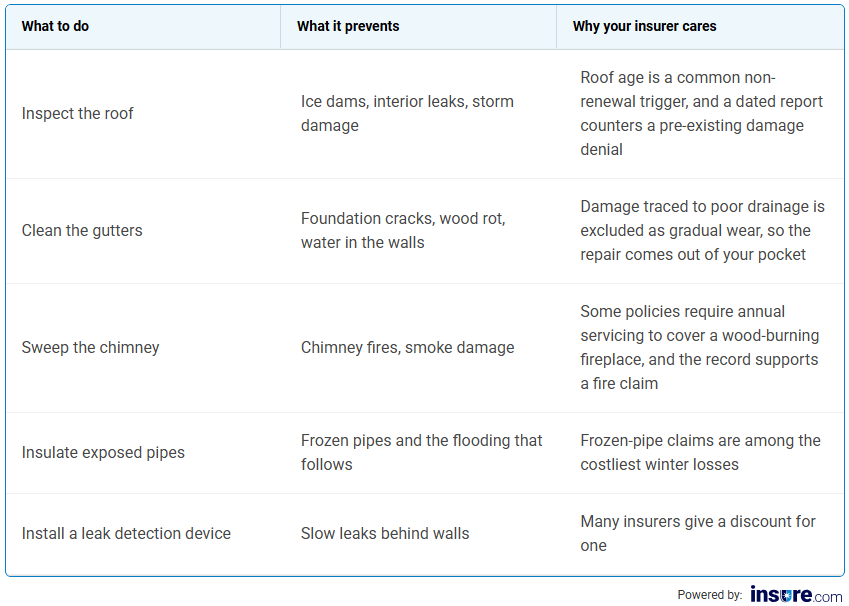
Home insurance pays for damage that's sudden and accidental, not deterioration that builds up over months. A roof going into winter with debris, worn shingles or open gaps hands the adjuster grounds to call the resulting leak wear and tear.
Water damage is one of the most common causes of home insurance claims during the winter, and a well-maintained roof is key to keeping your home dry.
A poorly maintained roof can be susceptible to the following, according to Nicholas Riley, owner of Driftwood Builders Roofing in Austin, Texas.
Book an inspection before the first freeze and keep the dated report. It establishes the roof's condition going into the season, which is the documentation an adjuster asks for when deciding whether a leak was sudden or long-running.
Five checks catch the damage that can lead to a winter leak. Most take a trained eye and a ladder, so a roofer's annual visit covers all of them in one trip for less than the deductible on a single water claim.
Handle these before the first freeze, and you go into winter with a roof that sheds water the way it's supposed to, plus a record of the work if you end up filing a claim.
Water coming off the roof has to land somewhere. When gutters are blocked, it spills over the edge and pools against the foundation, where it works into cracks and freezes. In cold regions, the same blockage feeds ice dams — ridges of ice at the roof's edge that back up meltwater under the shingles and rot the trusses underneath.
Both failures produce water damage that develops over time, which is the category most policies exclude. The foundation repair and the rotted framing come out of your pocket.
Riley says gutters need to be cleaned and checked so water flows through them freely. He adds that animals nest in gutters, and a nest blocks water flow the same way a season of leaves does — regular inspections catch them before they settle in.
Wait until the last leaves have dropped in your area, then work through the full run in one pass so you're not back on the ladder in three weeks.
Do this once the leaves are down and the water coming off your roof lands where it should, which keeps it out of the foundation and out of a claim your policy calls gradual damage.
Home fires happen more in winter than any other season, according to the National Fire Protection Association. A chimney that hasn't been swept is carrying a season's worth of creosote, which is what turns a normal fire into a flue fire that spreads into the framing around it.
Insurance turns on the servicing record. Some policies require an annual inspection to keep a wood-burning fireplace covered at all, and the report is what establishes that the flue was sound when the fire started. Your insurer may specify a technician certified by the Chimney Safety Institute of America — check your policy for the requirement before you book.
Work through these before the first burn of the season, since most of them are only visible when the flue is cold and empty.
Get this done before the first cold night, and you go into the season with a safe fireplace to burn and a record that satisfies the requirement in your policy.
A frozen pipe splits and then floods the house when it thaws, which is one of the most expensive claims a homeowner can file in winter. The claim also remains on your record and carries over to your next renewal.
Protecting the pipes themselves is only part of it. A pipe freezes because the surrounding space gets cold enough, so the furnace, the attic insulation, and the gaps around doors and windows all determine whether the plumbing ever reaches that point.
Many insurers offer a discount for a leak-detection device that shuts off the water when it detects a leak. Check your policy or ask your agent what your carrier offers.
Get through these before the first hard freeze, since several of them are difficult once the ground and the outdoor lines are frozen.
Fall home maintenance isn’t only about creating a comfortable home. It’s also about reducing your risk of an insurance claim and avoiding the higher premiums that can follow. Be sure to keep receipts, photos and inspection reports in case your insurer wants to see them.
“If you replace a roof or upgrade plumbing or electrical, tell your insurer,” Nissan-Cohen says. Those updates let an insurer know you are taking care of your home. They may even entitle you to premium reductions.
Spend a few hours on fall maintenance this year and reap the financial rewards of fewer claims and potentially lower premiums.
Does homeowners insurance cover roof leaks caused by ice dams?
Home insurance will generally cover damage caused by an ice dam so long as it is not the result of neglected maintenance or existing shingle damage. Insurers will not pay to remove the ice dam, however.
Can I do fall maintenance myself or do insurers require that I use a professional?
Many fall maintenance tasks, such as cleaning gutters and insulating pipes, can be done by homeowners. Insurers may require an annual professional inspection of chimneys and wood stoves as a condition of maintaining coverage.
Are burst pipes from cold weather covered by home insurance?
Burst pipes are often covered under home insurance dwelling coverage, so long as you take precautions to keep the house warm. If you turn off the heat while on vacation, for instance, and the pipes burst, then a claim would likely be denied.
Can my insurer refuse to renew my policy if I don't maintain my roof or gutters?
Yes, if an insurance company observes missing shingles, sagging gutters, or other signs of disrepair, they can choose not to renew your policy.
This story was produced by Insure.com and reviewed and distributed by Stacker.



