
For autistic people, masking—presenting yourself in a way, either consciously or unconsciously, to fit in better in a neurotypical world—can be both necessary and exhausting. That’s where the concept of “unmasking” comes in.
Unmasking is the process of making space for your autistic or neurodivergent traits to shine through in your day-to-day life. It's about working toward honoring your unique brain and what it needs, slowly letting go of the pressure to appear neurotypical.
“Unmasking, in the simplest terms, is about letting your nervous system participate in your life instead of fighting it all day,” says Stephanie Steele-Wren, Psy.D., a licensed psychologist specializing in adult autism. “It isn’t about turning into a different person or suddenly being ‘your real self.’ Unmasking is the gradual decision to stop overriding your nervous system to appear ‘acceptable.’”
But it’s important to note that autistic masking exists for a reason, and unmasking is not mandatory. Like most things related to autism, it’s not black and white. That’s why Prosper Health, the largest U.S. provider of mental health services for autistic adults, broke down what you need to know about unmasking, why it can be beneficial (when done safely), what it looks like in practice, and what supports can help.
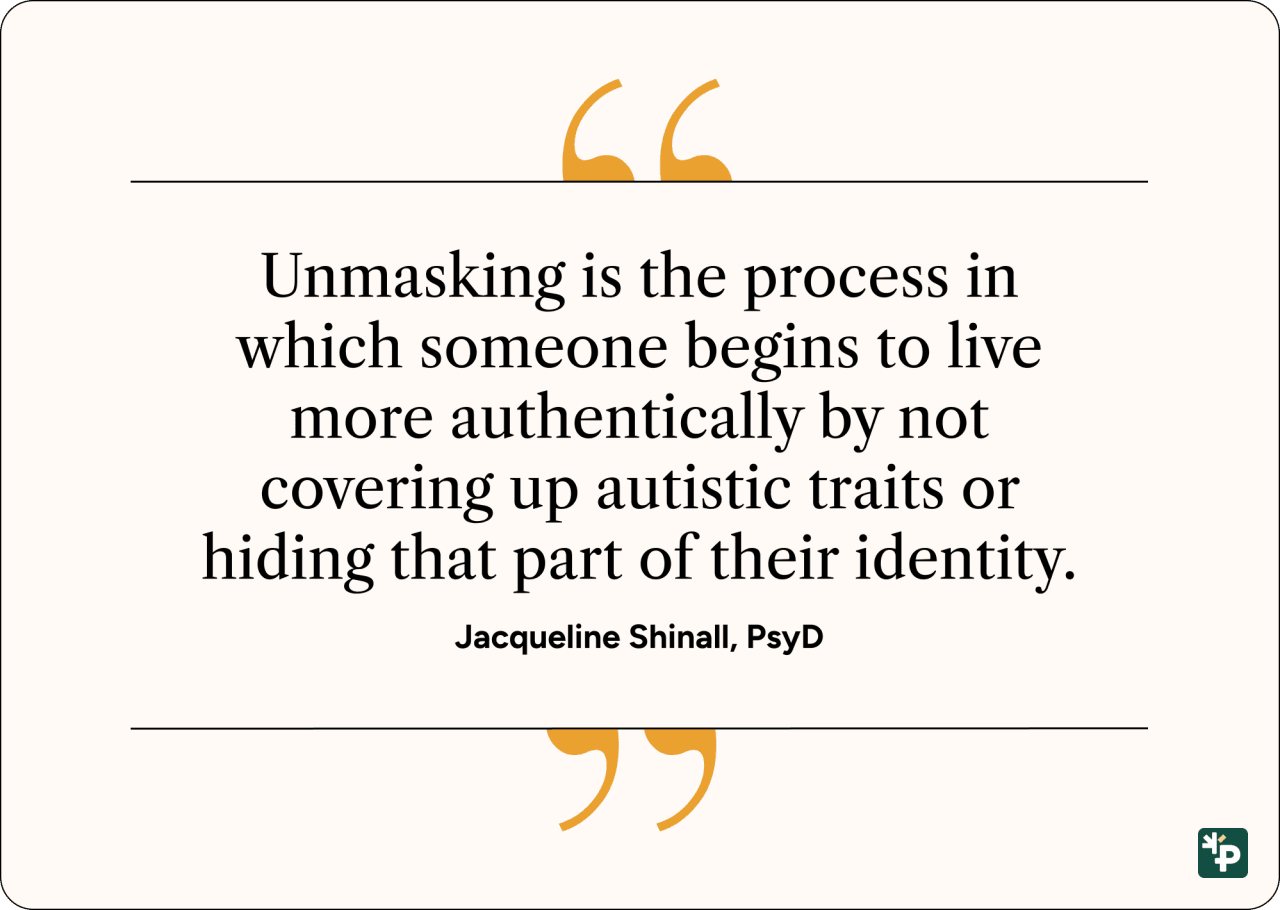
When autistic people mask, they’re attempting to hide, suppress, or camouflage their autistic traits. “Unmasking is the process in which someone begins to live more authentically by not covering up autistic traits or hiding that part of their identity,” says Jacqueline Shinall, Psy.D., head of reliability and quality assurance at Prosper Health.
Unmasking doesn’t mean becoming rude or insensitive, nor is it the loss of self-regulation or empathy. It simply means you’re putting less effort into appearing neurotypical. “Instead of performing a polished version of yourself, you allow your natural pauses, reactions, and needs to exist,” Steele-Wren says.
Chronic masking, especially when it’s unconscious, is one of the biggest contributors to burnout. “Masking requires someone to spend a significant amount of energy to do things that other people do automatically, such as using gestures, monitoring tone, making eye contact, etc,” Shinall explains. This level of effort is unsustainable as life demands increase.
Burnout is one of the biggest reasons adults start questioning their lifelong behavior patterns—something that could eventually lead to a late autism diagnosis. “For many adults, the question of neurodivergence only becomes unavoidable when the strategies that once kept life functioning stop working,” Steele-Wren says. “Burnout pushes people to confront the sheer amount of energy they’ve spent keeping up their mask.”
Everyone masks to a certain extent—especially in the workplace where there’s pressure to always be seen as “professional.” But for autistic people, masking is more than that.
Masking is a survival strategy where autistic people hide or suppress their natural autistic responses, identity, and behavior to avoid judgment. It allows autistic people to stay safe, accepted, or employed in a world that rewards conformity.
High-masking autism may also include camouflaging: copying behaviors and hiding certain traits to adapt to various social situations. Though masking may involve mimicking others' behavior, it often begins as an unconscious, learned behavior. “Most people don’t actively choose to mask,” Steele-Wren says. “They learn it early on through repeated feedback about what’s ‘too much’ or ‘unacceptable.’”
In addition to social situations, autistic adults may mask in order to meet workplace expectations, deal with healthcare bias, or feel safer because of their gender, race, or LGBTQIA identity. “In adulthood, masking is often driven less by needing to fit in socially and more by consequences,” Steele-Wren says.
People may mask to keep their jobs, or to receive good healthcare—especially to avoid being dismissed or misdiagnosed. “These pressures are amplified for people who are women, people of color, LGBTQIA+, or marginalized otherwise,” she explains. “Being visibly different can carry true emotional, professional, or even physical risks.”
Masking can take many forms and varies person-to-person. “In everyday life, masking might look like pushing through sensory overload in public spaces, making social scripts and practicing them, making yourself laugh at jokes you don’t really understand, or hiding exhaustion until you’re alone, or fully burnt out,” Steele-Wren says.
Here are a few real-life examples of neurodivergent masking across different areas.
Communication
Sensory suppression
Emotional regulation
Identity masking
But it’s important to keep in mind that many people don’t know that they’re masking—it happens unconsciously. Masking may also feel like “normal adulthood,” suppressing behaviors like stimming to fit in.
There are two types of unmasking: internal and external. “Internal unmasking is the cognitive and emotional work of reducing or letting go of internalized ableism or self-judgment, which allows someone to live authentically without shame or beliefs that they need to change or hide,” Shinall explains.
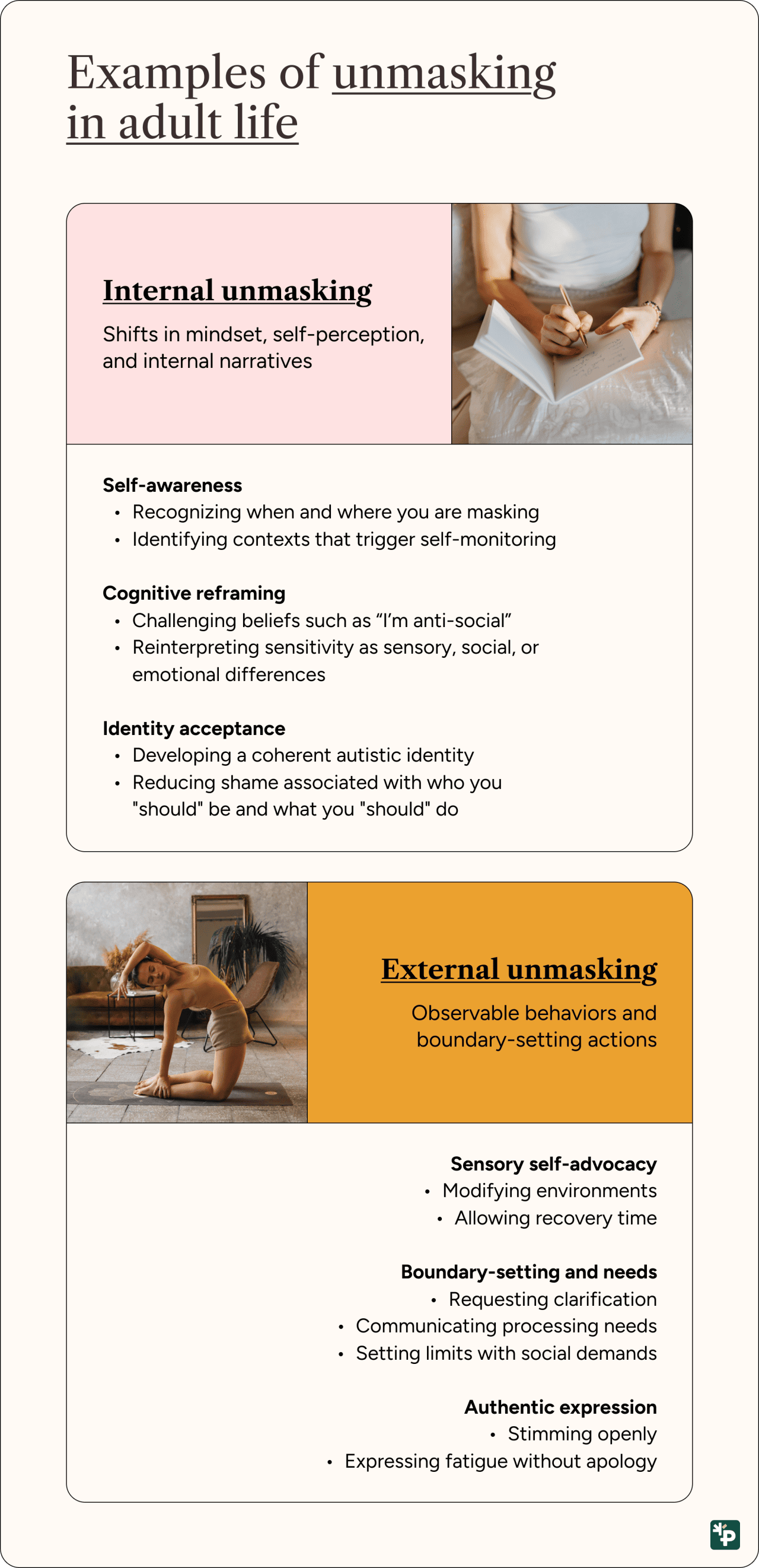
Internal unmasking is where the real transformation begins. “You start noticing the hidden labor you’ve been doing for so long: the constant self-monitoring, the creating scripts, the rehearsing,” Steele-Wren says. “And you realize none of that was ever ‘easy,’ you just got used to doing it.”
Internal unmasking often happens before external unmasking and makes it possible. “Someone must believe internally that their autistic traits are acceptable before they feel comfortable showing them externally,” Shinall says.
Examples of internal unmasking include:
External unmasking is when autistic people stop covering up autistic traits or hiding that part of their identity. “These are the small, visible changes you make that other people might notice,” Steele-Wren says. “For example, you might allow yourself to stim gently instead of keeping every movement still and ‘acceptable.’”
External unmasking isn’t about making bold statements: It’s about reducing the amount of acting you do in your day. “Instead of performing and acting out an emotion to make someone else comfortable, you let your real reactions be smaller, delayed, or different than what you think others expect,” Steele-Wren explains. “These external changes are usually subtle, but they create huge shifts in your ability to function around others without burning out.”
Examples of external unmasking include:
Partial, situational, or reversible unmasking is the context-dependent approach where autistic people adjust their level of masking based on factors like safety, acceptance, potential consequences, as well as level of energy or fatigue.
“Most autistic adults do not unmask everywhere,” Steele-Wren says. “They unmask where the cost of being seen is lower than the cost of continued suppression. In real life, that might mean you unmask around your partner but still mask at work.”
According to Shinall, partial unmasking can be considered a pragmatic survival strategy. It acknowledges the reality that, unfortunately, not all environments are equally safe for autistic people. “This kind of unmasking is flexible and completely valid,” Steele-Wren says. Partial unmasking allows someone to manage their energy, safety, and authenticity across different contexts in their life.
Examples of partial, situational, or reversible unmasking include:
Unmasking is not an all-or-nothing approach. Like most other things, masking occurs along a continuum and is impacted by many different factors. “You try something small, assess the impact, and adjust again,” Steele-Wren explains. “Sometimes you unmask more. Sometimes you pull back. Sometimes you mask intentionally because it’s the right choice for the moment.”
These shifts happen constantly. For example, it may be harder for an autistic person to mask when they’re feeling tired or burned out. “One environment might feel safe one month and unsafe the next,” Steele-Wren says. “One relationship might allow deeper unmasking over time. Unmasking works best when it’s treated as flexible and fluid.”
The main benefit of unmasking isn’t about being “more authentic”—it’s about being able to live life without feeling like you're always on the verge of burnout. “When you stop fighting your own nervous system so intensely, you conserve energy instead of spending it all at once,” Steele-Wren explains. “You recover faster, burn out less, and feel more grounded in your own body.”
In addition to reducing burnout, some of the other potential benefits of unmasking include:
Of course, everyone is different, and the potential benefits of unmasking vary and are not guaranteed.
While unmasking can be powerful and a positive experience, it’s not without risks and limits.
For instance, not every environment is accepting. Some workplaces, families, or communities penalize differences. “Masking can be a shield in those situations,” Steele-Wren says. “Fear around unmasking is really to be expected because it is often an accurate risk assessment, shaped by experience.”
Also, there are good reasons people mask: It can help keep you safe, navigate unpredictable environments, or even give you privacy. “The problem isn’t masking itself, but when it’s constant, unchosen, and draining,” Steele-Wren says. “The goal is to identify where masking protects you and where it harms you.” Sometimes it’s a matter of prioritizing safety over authenticity.
Some risks and limits to consider when starting to unmask:
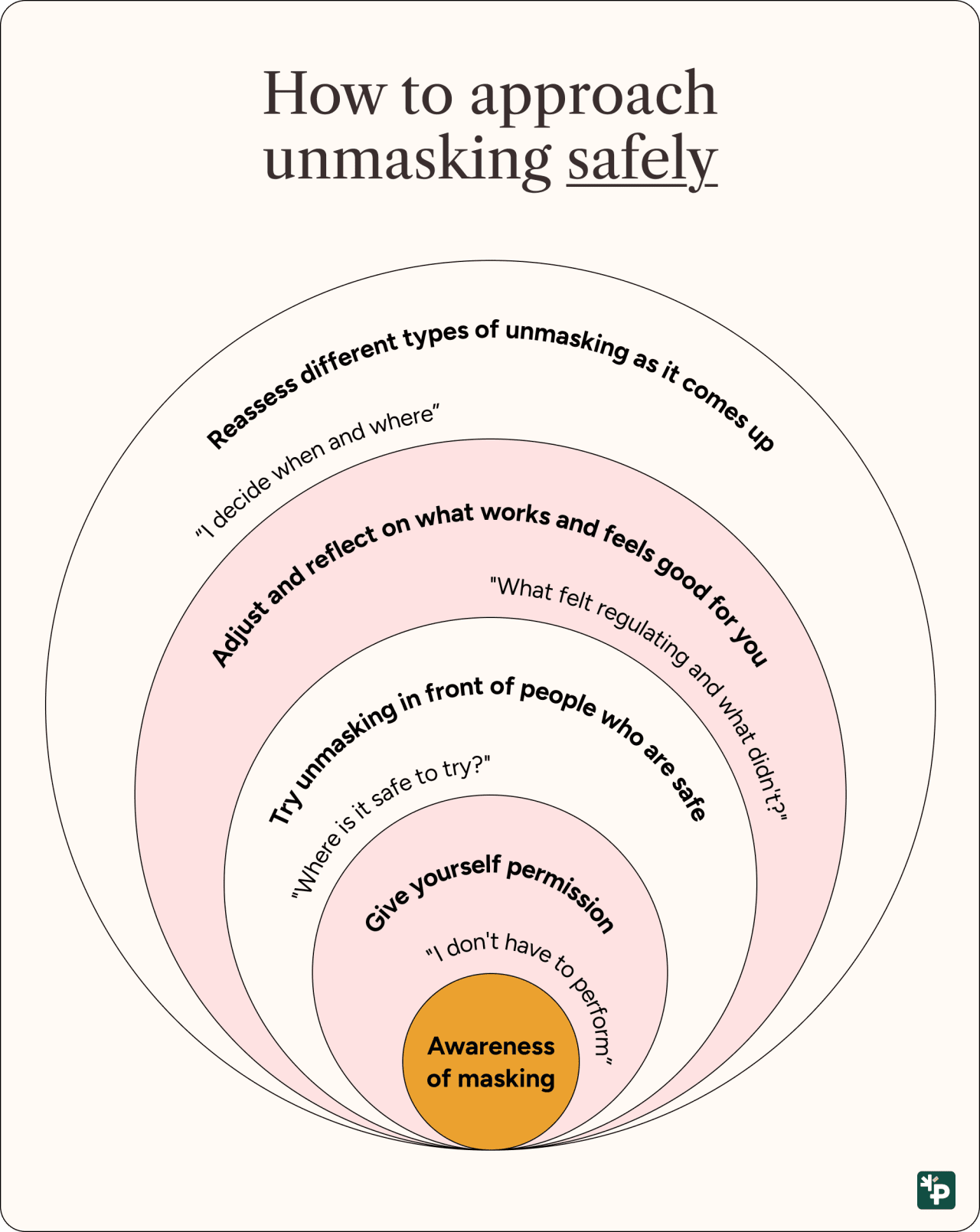
It’s often safest to begin unmasking internally. “Start by allowing yourself to recognize discomfort, sensory overload, or social fatigue without immediately pushing yourself past those feelings,” Steele-Wren says. “From there, you can experiment gently. It might be speaking a little more plainly with a trusted friend, or giving yourself permission to stim in a private space.”
The goal is to find environments where your nervous system doesn’t brace for impact. Safe unmasking is slow, steady, and guided by your body’s feedback. You can reverse course anytime and go back to masking, if necessary.
There’s no need to jump into making major changes. Instead, start with tiny, manageable shifts. This could look like letting yourself pause before answering, instead of rushing to fill the silence, Steele-Wren says. It could also be saying no to someone without giving them a long explanation, letting yourself stim gently at home, or adjusting your environment to be more sensory-friendly.
“Low-risk experimentation often starts with giving yourself permission,” she explains. “Permission to have needs, to rest, to speak differently, to move differently, to not outperform your own limits.”
While unmasking is an individual choice, it helps to have support from people who already accept the way your brain works. You can find them from multiple sources, including:
“Being in a space where you’re not performing all the time can be transformative,” Steele-Wren says. “With the right support, unmasking can feel less like stepping into danger and more like gradually reconnecting with yourself in a regulated, sustainable way.”
While unmasking may be beneficial, it’s not without its risks. That’s why it’s important to remember that unmasking is optional, and masking is not failure. In our quest to live as authentically as possible, safety and self-trust matter. “It’s about giving yourself and your body the dignity of being listened to,” Steele-Wren says.
What does unmasking look like?
Unmasking can take many different forms. For example, it could include stimming openly, admitting you’re tired instead of faking energy, or asking someone to repeat something you didn’t understand. Managing sensory stimulation can also be a form of unmasking, like wearing headphones/earbuds or sunglasses indoors, changing lightbulbs to a certain brightness, covering ears in response to painful sounds, or only wearing certain types of clothing.
How do you know if you're masking?
People usually don’t notice they are masking in real time—they tend to notice afterward. “Many people recognize masking not through behavior, but through the aftermath that follows everyday interactions,” Steele-Wren explains. “You might think you’re ‘fine’ during social events and only realize hours later that you’re completely wiped out, mentally foggy, or physically tense. That delayed cost is one of the clearest signs of masking.”
Is unmasking always healthy?
No, unmasking is not universally the best option. Safety, support, and context can make it beneficial, but it can be risky or even harmful in places where difference is punished. “The idea that you should ‘be your true self everywhere’ simply isn’t realistic for many autistic adults,” Steele-Wren says. The healthiest approach is to match your level of unmasking to your level of safety. “Unmask where you can breathe,” she says. “Mask where you must. The flexibility is what makes it sustainable.”
This story was produced by Prosper Health and reviewed and distributed by Stacker.



