
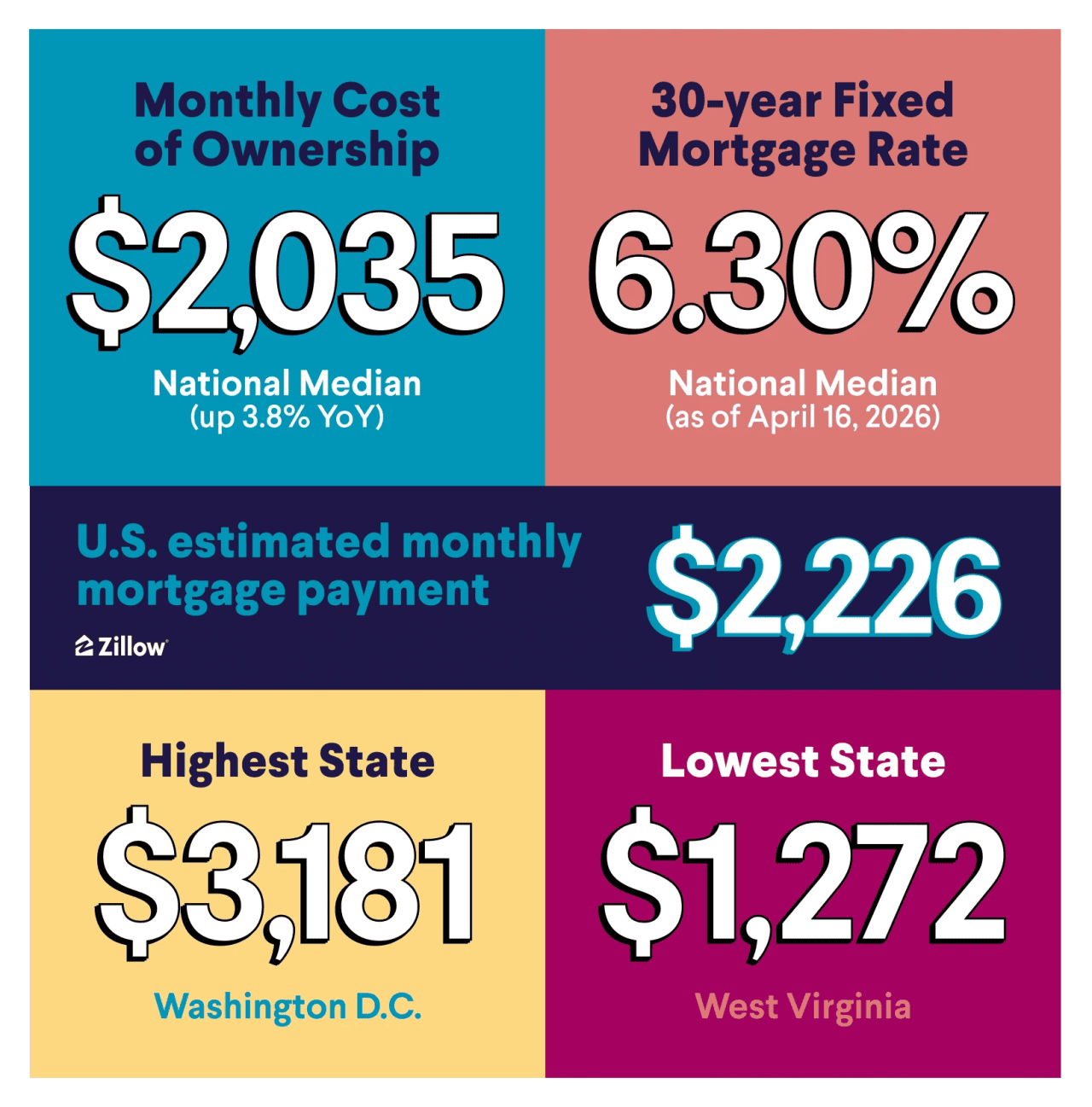
The median monthly cost of homeownership in the U.S. now sits at $2,035, according to data from the Census Bureau. That figure, which includes mortgage payments, property taxes, homeowners insurance (fire, hazard, and flood), utilities, and applicable condo or HOA fees, is up 3.8% from the year prior. In some states, like California, Hawai'i, and New Jersey, it’s even higher.
Home prices have stabilized somewhat since their post-pandemic peak, but affordability pressure hasn’t eased much.
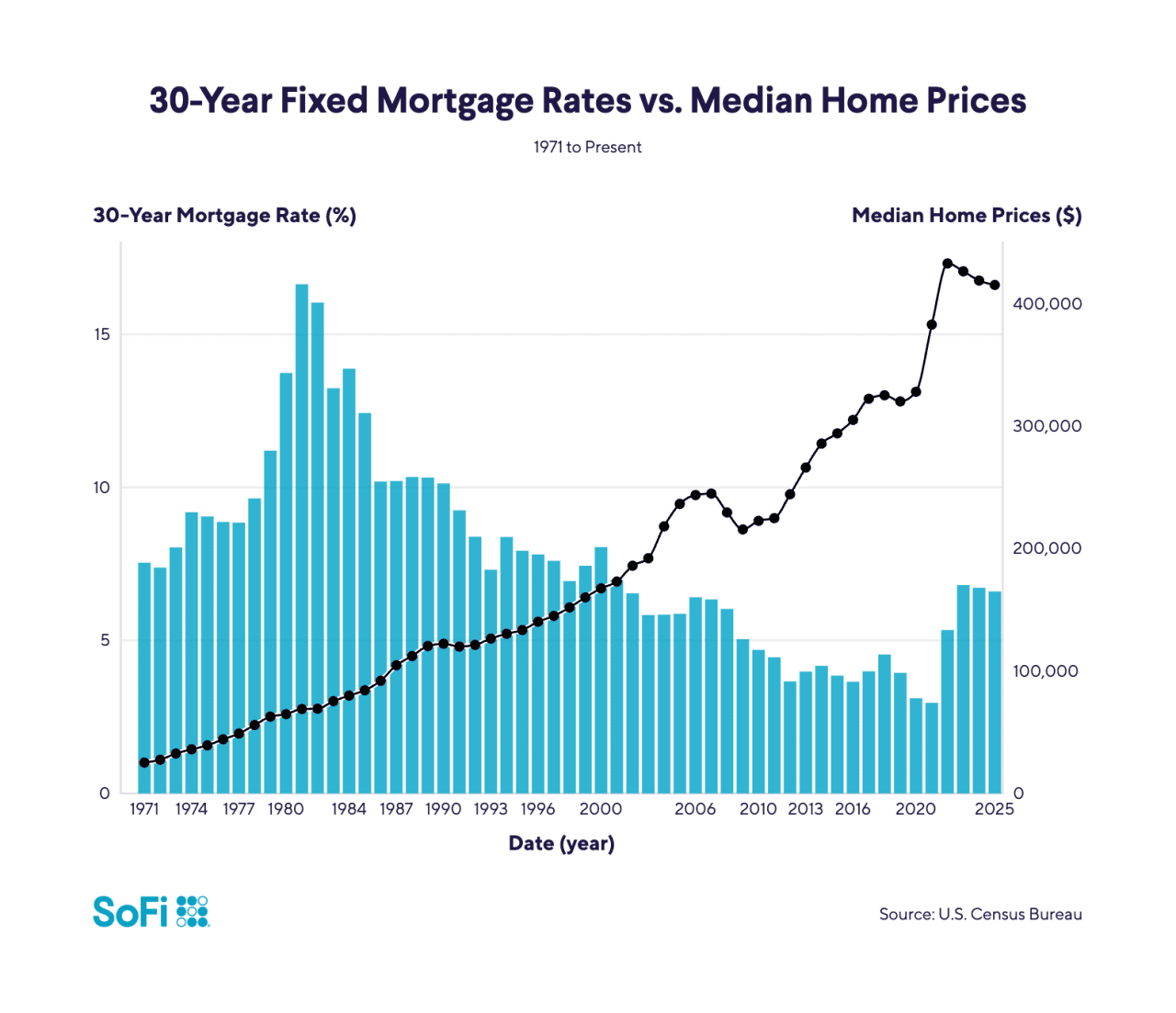
According to Federal Reserve Economic Data (FRED), the median sales price of homes sold in the U.S. stands at $405,300 as of late 2025. And according to Freddie Mac, the average 30-year fixed rate has held at above 6% for much of the past year. Elevated values plus persistent borrowing costs add up fast.
This study from SoFi uses the latest home value data and mortgage rate benchmarks to examine affordability at the state and metro levels, including median and estimated monthly payments by state and the reasons costs differ by location.
A recent Gallup study found that 62% of Americans currently own a home. Less than a third (30%) of nonhomeowners expect to buy property within the next five years. Only about a quarter anticipate becoming homeowners in the next decade.
Gallup cites affordability as a major concern. One of the biggest drivers of affordability pressure is mortgage rates. These remain near recent highs as of April 16 at:
The median sales price of homes sold in the U.S. stood at $405,300 in the fourth quarter (Q4) of 2025. Prices have stabilized somewhat from their post-pandemic highs ($442,600 in Q4 2022), but they remain well above where prices sat in Q2 2020, when the median was $317,100.
That appreciation, paired with 6.00%-plus 30-year fixed interest rates, has pushed up monthly ownership costs. The Census Bureau’s American Community Survey found that median monthly owner costs reached $2,035 in 2024, up 3.80% year over year (YoY).
More recent data from the Mortgage Bankers Association puts the current median payment at $2,061.
Not every state carries the cost burden seen in D.C. or California. Across much of the Midwest and South, median monthly owner costs fall well below the national figure of $2,035.
The states with the lowest medians are:
The gap between the lowest and highest costs is substantial. West Virginia’s median of $1,272 sits $1,909 below D.C.’s $3,181. That’s a difference larger than the median monthly cost in all 10 lowest-cost states.
The regional pattern is consistent. All 10 of the lower-cost states fall within the South or Midwest, according to Census Bureau geographic classifications:
The full 50-state picture (plus Washington, D.C.) is below, ranked from highest to lowest. The national median of $2,035 serves as a useful benchmark, with 18 states sitting above it.
Of course, housing costs vary significantly based on where you live. Everything from home prices to mortgage rates is location-dependent. The states (including Washington, D.C.) where the median monthly owner costs are steepest are:
In D.C. and California, the median monthly cost is about $1,000 higher than the national median payment amount ($2,035). New Hampshire and Maryland sit closer to the national figure, though even a few hundred dollars per month adds up against the broader cost of living in those states.
Know that these higher-than-average costs reflect structural affordability, not real-time pricing. Metro-level figures later in this study draw from more recent Zillow data in an effort to capture current market conditions more closely.
Several factors drive costs higher in these states:
Note that all figures cited here are medians. The median often better reflects typical affordability conditions than the average, which can be skewed by high-cost outliers at either end of the market.
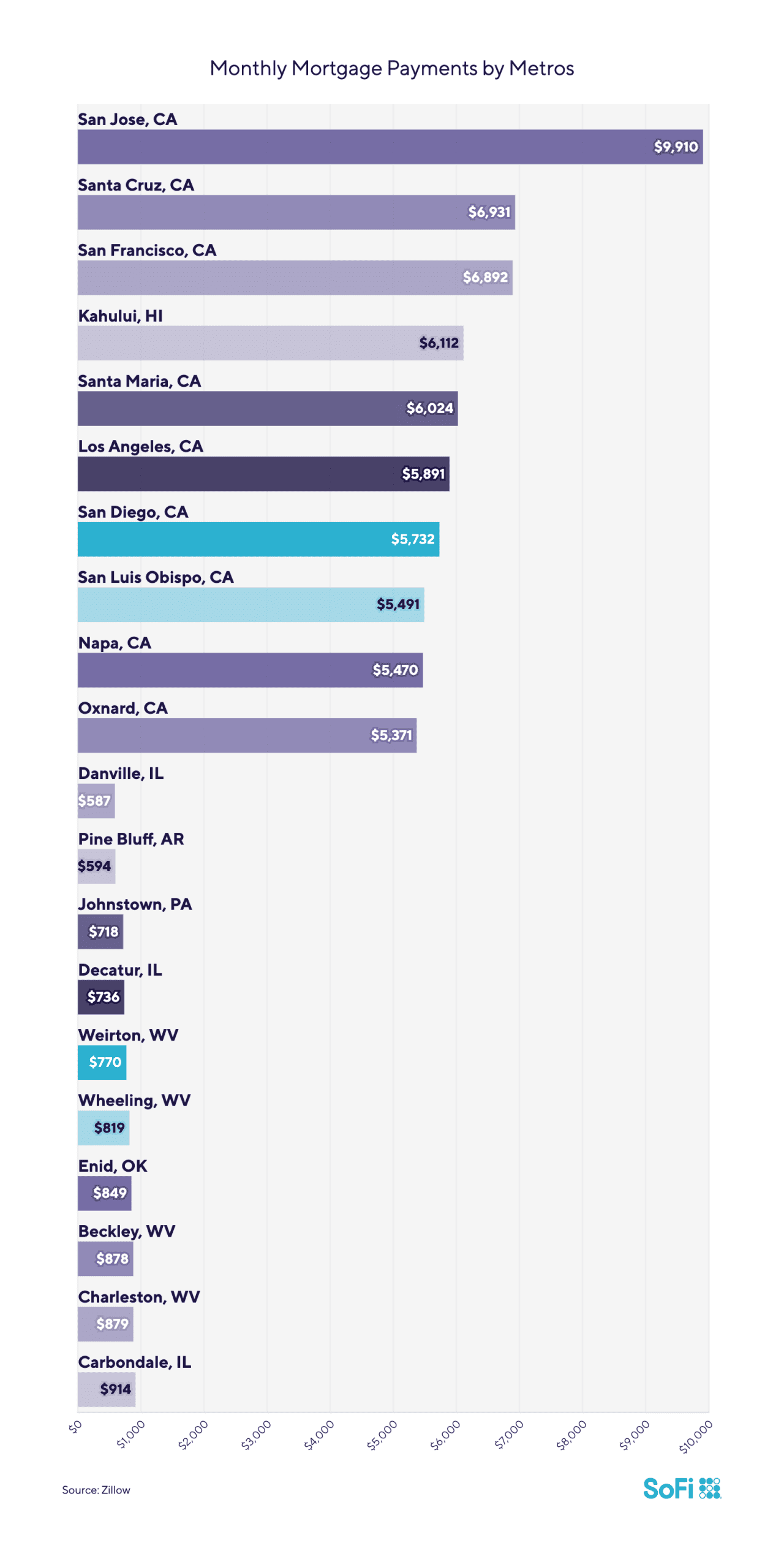
While state-level data shows broader affordability trends, metro-level data shows real-time market pressure. Within a single state, costs can vary considerably. The figures below are drawn from Zillow data as of Feb. 28, 2026, and represent estimated monthly mortgage payments on a new home purchase at current rates.
The 10 metros with the highest estimated monthly mortgage payments are (ranked highest to lowest):
Nine of the 10 most expensive metros are in California. The sole outlier is Kahului, Hawai'i. San Jose leads by a considerable margin. Its $9,909 monthly figure is more than $2,900 ahead of the next closest metro. The estimated mortgage payment in these metros all exceeds $5,000.
And the 10 metros with the lowest estimated monthly mortgage payments are (ranked lowest to highest):
None of the 10 lowest-cost metros surpass the $1,000 per-month mark. And nine of the 10 metros are located in Midwestern or Southern states, with the Northeast’s Johnstown, Pennsylvania, being the lone exception.
Several factors likely drive the variation:
State-level figures are based on median monthly owner costs sourced from the U.S. Census Bureau’s 2024 American Community Survey, the most recent year available.
Metro-level figures use Zillow data as of Feb. 28, 2026. Zillow’s metro data is based on estimates of the monthly mortgage payment on a new home purchase with the average interest rate of that month. The home value is estimated using smoothed and seasonally adjusted Zillow Home Value Index (ZHVI). If the down payment is less than 20%, the monthly mortgage payment includes 1% mortgage insurance.
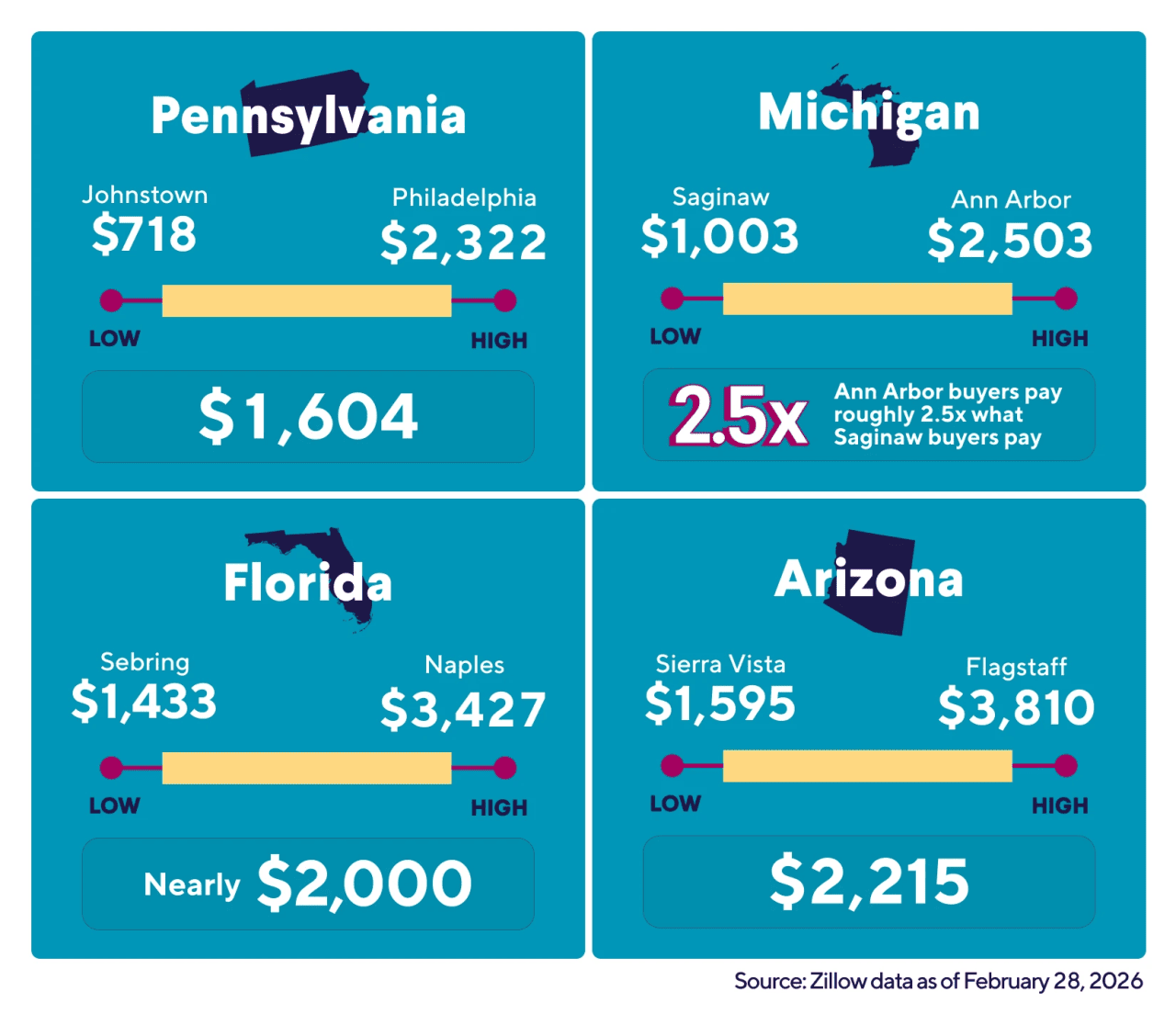
Within a single state, costs can swing by thousands of dollars depending on the metro. Using Zillow’s data, here’s how that dynamic plays out in select states:
Location is one driver of cost variation, but housing inventory and population growth shape what buyers pay, too. The regions with the highest growth in 2025 were:
Coastal states currently carry the highest monthly costs, while much of the Midwest and South remain more affordable.
Higher monthly costs have concrete consequences for buyers trying to enter the market. They can:
For current homeowners, mortgage refinancing is one option for reducing monthly costs, though it comes with its own trade-offs depending on the rate environment and the remaining loan term.
The data makes clear that where you buy matters as much as what you buy. Monthly owner costs in California, Hawai'i, and D.C. run more than double those in West Virginia, Arkansas, and Indiana. And within any given state, the spread between metros can be just as wide.
The monthly payment is the key affordability metric if you’re in the market for real estate. But it’s also a good idea to evaluate total cost versus just the home’s price tag. Interest rates, property tax, insurance, and HOA fees all feed into what homeownership costs month to month. An online mortgage interest calculator can help you do the math on the total costs of a loan.
What is the average mortgage payment in the U.S.?
As of April 16, 2026, the average interest rate on a 30-year, fixed-rate loan is 6.3%. Meanwhile, the average sales price of all homes sold in the U.S. was $534,000 (Q4 2025). Assuming these averages and a 20% down payment, the average monthly mortgage payment sits at around $2,664. This amount includes only the principal and interest, not any taxes, insurance, or other fees.
That figure is higher than the Census Bureau’s median monthly owner costs of $2,035, which reflects what existing homeowners with a mortgage actually paid in 2024. The median is generally the more useful affordability benchmark, as it represents the midpoint across all current mortgages and is less sensitive to high-end outliers than the average.
How are monthly mortgage payments calculated?
For fixed-rate mortgages, lenders generally calculate monthly payments based on three factors: loan amount, term, and interest rate. Getting a smaller loan typically means a lower monthly payment, unless you also go with a shorter term. That’s because shorter terms usually mean higher monthly payments. A higher interest rate can also increase payment amounts.
Taxes and insurance can also affect your mortgage payments. When financing (or refinancing) a mortgage, property taxes are typically included in those payments. The same can be said of homeowners insurance.
You can use an online mortgage calculator to determine your estimated monthly payment based on different values (home price, down payment, and interest rate).
Why do mortgage payments vary by state?
The law of supply and demand is one of the biggest reasons why mortgage payments vary so much. Some states — like New York — have more limited housing supply than others. When demand is higher than supply, housing prices tend to rise. This often means larger loans, which can result in higher interest rates (and higher monthly payments).
Variances in state lending laws and competition can also affect mortgage payments. For example, states with strict usury laws (limits on interest rates) might see lower mortgage payments (depending on housing costs).
Which states have the highest mortgage payments?
The states with the highest monthly owner costs are California ($3,001), Hawai'i ($2,937), New Jersey ($2,797), New York ($2,544), and Washington ($2,519). The District of Columbia has the highest monthly owner cost at $3,181.
Which states have the lowest mortgage payments?
The U.S. states with the lowest monthly owner costs are West Virginia ($1,272), Arkansas ($1,375), Mississippi ($1,448), Kentucky ($1,453), and Indiana ($1,466).
Homeownership costs also vary by metro. For example, the median listing price of homes in West Virginia is just shy of $250,000, which may account for the lower monthly payment amounts. But in some parts of the state — like Winchester — prices are much higher.
How do mortgage interest rates affect monthly payments?
A monthly mortgage payment includes two main components: principal and interest. A higher interest rate typically means larger monthly payments, while a lower rate means smaller monthly payments. Factors like loan term and amount can also impact your monthly payment. As you shop around, check the current mortgage rates by lender for a better idea of what to expect.
What is included in a typical mortgage payment?
A mortgage payment typically includes the principal, which is the original amount borrowed to buy the home. It also includes the interest, which is the cost of borrowing money from a lender.
In most cases, your monthly mortgage payment will also include escrow for property taxes and homeowners insurance. If you put less than 20% down on a conventional loan, you may be required to have private mortgage insurance (PMI), which adds to your monthly payments.
How can I lower my monthly mortgage payment?
Even if you pay around the average mortgage payment amount for your state, it might be eating into funds that could be spent on other things, such as your retirement savings. One way to lower your payment is to get rid of PMI (if you’re paying it). Your lender will often automatically remove it for you once you have 22% equity in your home. You can, however, request that it be removed as soon as you reach 20%.
The other method is through a home mortgage refinance. This could get you a longer term (with a lower monthly payment). Or it might result in a lower interest rate (also with a lower monthly payment).
This story was produced by SoFi and reviewed and distributed by Stacker.



