
When you're planning a vacation, are you the type that looks for the most efficient route using a reliable GPS? Or are you working with a travel agent who tailors every detail to your specific needs?
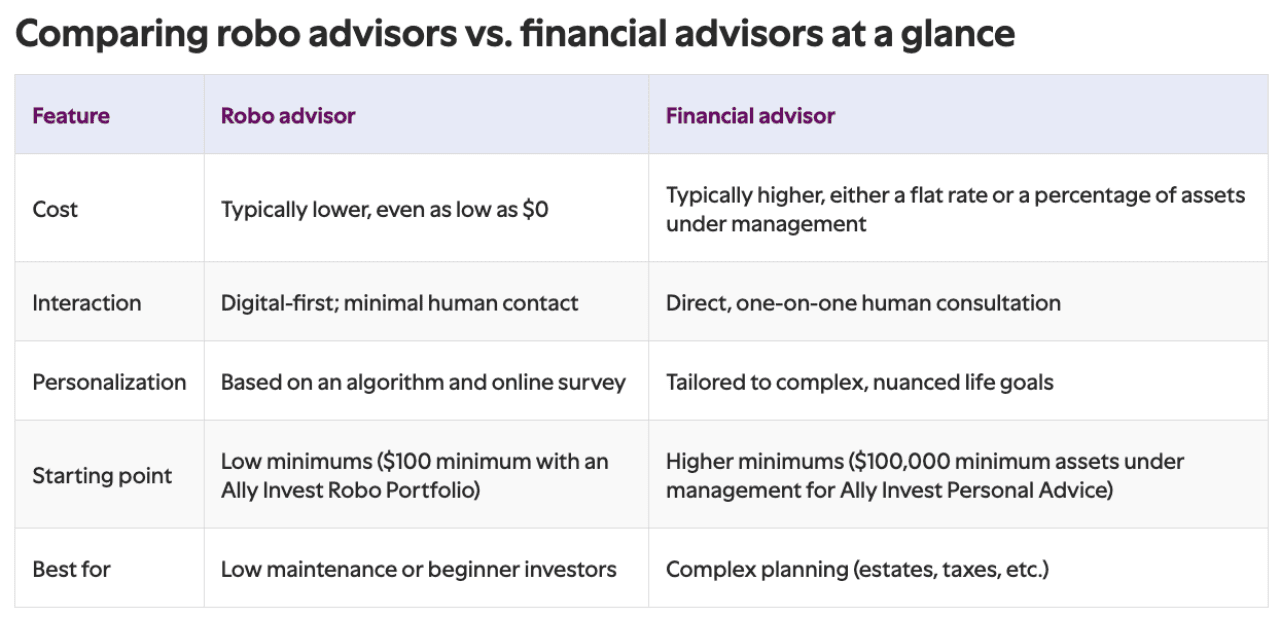
Deciding between a robo advisor and a financial advisor can be somewhat similar. One offers high-tech automation that aligns with what you input into the system, while the other provides human expertise for a more customized experience. Ally Financial shows how to compare the two when deciding which one — or combination of both — makes sense for you.
A robo advisor is a digital service that manages your investments using computer algorithms, sometimes with an element of human supervision. Typically, it's considered a more hands-off approach to investing (though any portfolio should be monitored regularly). The algorithms are designed by behind-the-scenes experts, but your day-to-day experience likely happens through an app or website.
Pros and cons of using a robo advisor
Let's dive into a few of the benefits and drawbacks of robo advisors.
Pros of a robo advisor:
Cons of a robo advisor:
A financial advisor is a licensed professional who helps you manage your money for your specific circumstances. Unlike a robo advisor, this is a real person or team of people you can call, email, or meet with to discuss your financial life in depth.
A financial advisor does a lot more than just pick stocks. A good advisor looks at your entire financial picture to offer:
Tip: When looking for a financial advisor, check for one that is a fiduciary, meaning they are obligated to act in your best interest.
Pros and cons of using a financial advisor
Let's dive into a few of the benefits and drawbacks of financial advisors.
The pros of financial advisors:
The cons of financial advisors:
Costs of using a financial advisor
Typically, you’ll pay around 1% of the assets they manage for you. So, if they’re managing $100,000, you’d pay $1,000 a year. Fees often drop as your assets grow, but it’s almost certainly a bigger investment than a robo advisor.
So, which one wins? It really comes down to your personal style and where you are in your financial journey.
Ultimately, whether you decide on a robo advisor, a financial advisor, or a hybrid of both, the key takeaway is this: By understanding your own needs today, you’re taking an important step as you pursue a financial future that fits your unique life.
This story was produced by Ally Financial and reviewed and distributed by Stacker.



