
Retail investors love to believe they’re calm, calculated, and immune to hype. But when markets swing and social feeds light up, emotions often take over. In 2026, that pull is hard to escape. Interest-rate uncertainty, sharp swings in artificial intelligence and chip stocks, and a constant churn of trading talk on social media keep emotions close to the surface. MarketWise surveyed 1,002 U.S. retail investors to examine how fear, fear of missing out (FOMO), AI tools, and social media are affecting modern trading behavior, and how much those decisions are costing investors in real dollars.
AI headlines can move investors even when the news is good. When Nvidia, the chipmaker at the center of the AI boom, reported record earnings in May 2026, it beat Wall Street’s revenue and profit estimates and raised its outlook. Investors sold anyway, sending the stock lower for the fourth straight quarter after a strong report. Many had piled in ahead of the report on AI hype, then pulled back the moment the news landed.
Sentiment can swing just as fast in the other direction. Goldman Sachs Research saw its U.S. investor sentiment gauge flip from negative in late March to positive by late April, a mood shift from fear to optimism in a matter of weeks. Goldman tied the rebound to a market rally, easing geopolitical worries, and rising corporate confidence, with AI spending alone projected to drive about 40% of S&P 500 earnings growth this year.
That is the backdrop for this survey. When prices move fast and headlines pile up, emotion is hard to separate from strategy, and the cost of reacting can be steep.
Fear, hype, and uncertainty are pushing investors to make choices they may not have planned to make. Many are also turning to AI for reassurance, guidance, or a second opinion in high-stress moments.
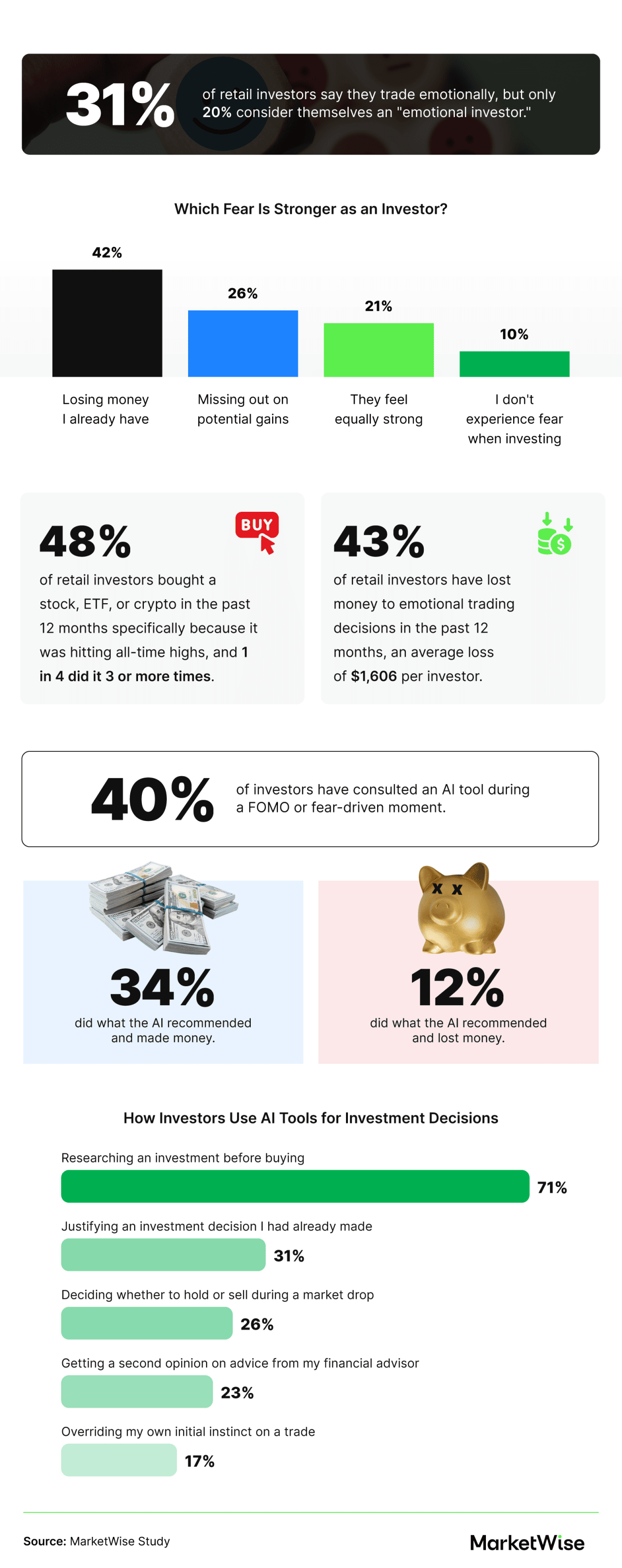
Only 20% of retail investors describe themselves as emotional investors, yet 31% admit they trade emotionally at least some of the time, and 48% made a FOMO-driven purchase in the past 12 months by buying an asset hitting all-time highs.
The differences between emotional and rational investors show up quickly in their trading habits and media consumption. From Reddit to financial advisors, the sources investors trust often influence how they respond when markets move fast.
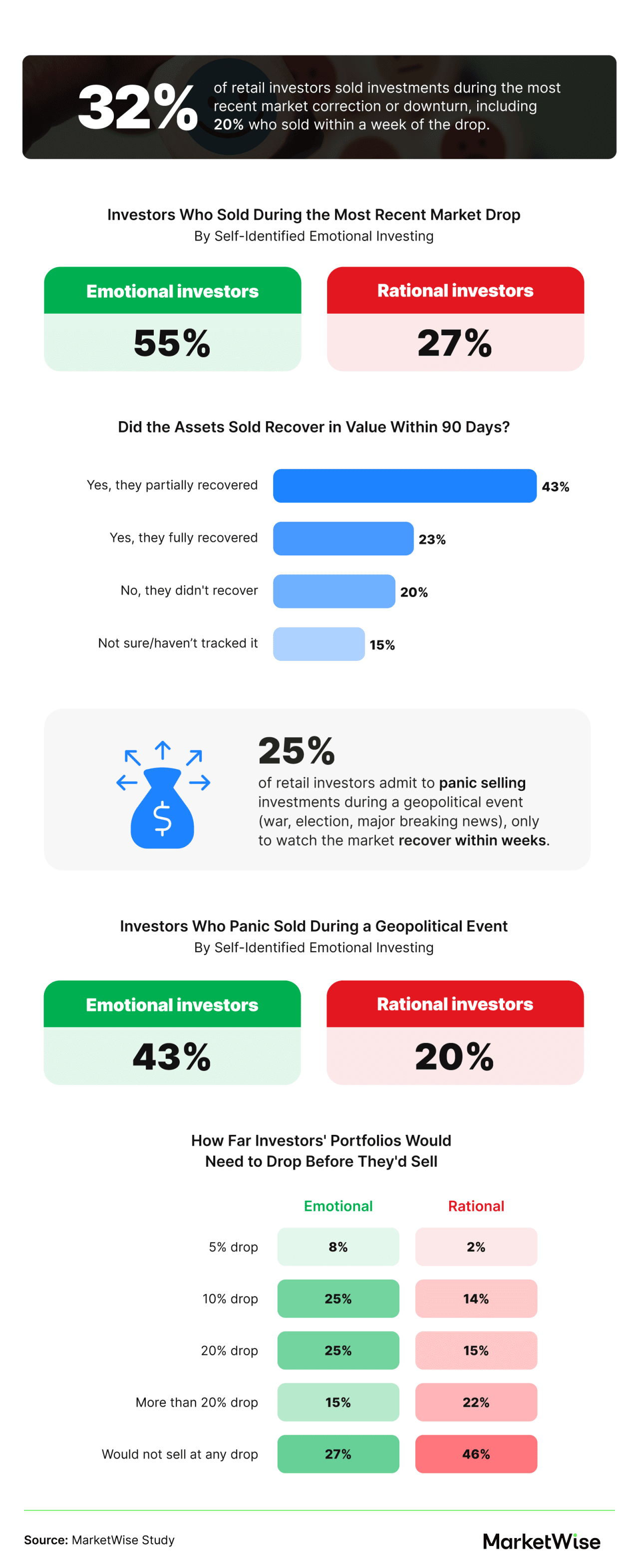
No matter how far their overall portfolios dropped, 43% of investors say they would never sell their investments. The remaining investors surveyed would sell at these drops:
52% of retail investors have followed a financial influencer. Among them, 34% lost money, and 18% made money. 30% of investors have placed a buy or sell trade within 24 hours of seeing related content on social media.
Top sources self-identified emotional investors use to inform their buy or sell decisions:
Top sources rational investors use to inform their buy or sell decisions:
Who investors trust most when making investment decisions:
MarketWise surveyed 1,002 U.S. retail investors about their emotional trading habits, the dollar amounts they have lost from emotional trades, the information sources they rely on, and how AI tools factor into their investment decisions. Respondents represented a mix of experience levels, portfolio sizes, and generations. The generational breakdown was 52% millennials, 26% Gen X, 14% Gen Z, and 8% baby boomers. Data was collected in May 2026.
This story was produced by MarketWise and reviewed and distributed by Stacker.



