
If student loan debt is costing you too much, it may be an option to pay off your student loans with a home equity loan.
If you’ve built up some equity, a home equity loan could be a relatively cheap and easy way to borrow. Under certain conditions, it might make sense to use it to pay off student loans.
This guide from Freedom Debt Relief on how home equity works could help you figure out whether using it for student loans is worthwhile in your situation, and it also explains three different methods to use your home equity to pay off student loans.
Key Takeaways:
A home equity loan is a mortgage. Instead of using the money to buy a home, however, you could use it for other purposes since you already own the property.
The equity in your home is the value of the property above what you still owe on your mortgage, or, in other words, market value minus outstanding debt. For example, if your home is worth $250,000 and you owe $200,000 on your mortgage, you have $50,000 in equity.
You build equity when your home’s value increases, and as you pay down your mortgage. Continuing with the example, let’s say you’ve made payments for a few more years and your mortgage balance is down to $180,000. At the same time, the home’s value has risen to $295,000. You now have $115,000 in equity.
Home equity loans are secured by your home. That collateral is a financial safety net for the lender. If you don’t repay the loan, you could lose your home, because the lender can sell it to recover what you owe.
That security gives home equity loans two big advantages—they're cheaper than most other borrowing options, and they’re relatively easy to get. Home equity loans typically have lower interest rates than other kinds of loans, and in some cases have more flexible credit requirements.
If you have equity in your home, a home equity loan could be a source of funds to pay off student debt or to continue paying for your education.
Lenders typically don't let you borrow the full value of your home equity. For example, a lender might limit your combined total mortgage debt to 80% of what your home is worth. Some lenders have higher limits.
With an 80% limit and a $295,000 home, the maximum you could owe on your home, between your mortgage and your home equity loan or HELOC, would be $236,000. If you still owe $180,000 on your mortgage, that means you could apply to borrow another $56,000.
If you have enough equity to borrow against, here are a few ways you could do it.
1. Cash-out refinance loan
A cash-out refinance means taking out a new mortgage for more than you currently owe. You use the loan proceeds to first pay off your existing mortgage loan, and then get the difference in cash. You could use the money you borrowed to pay for school or pay off student loan debt. This kills two birds with one stone. It allows you to:
Cash-out refinancing means you aren't just changing the terms of your student loan debt, but also changing the terms of your current mortgage.
To decide whether this is a good idea, look at both decisions separately. Consider refinancing student loan debt if you can get better terms on a new loan. This could mean lower interest rates and/or lower monthly payments.
Even if you can improve on the terms of your student loan debt, it’s only worth it to use cash-out refinancing if you can also improve on the terms of your current mortgage.
For example, it probably wouldn't make sense to trade in a low-rate mortgage for a higher-rate mortgage just to refinance your student loan debt. In that case, it may be more cost-effective to leave your current mortgage in place, and take out a home equity loan to pay off your student loan debt.
2. Home equity loan
Home equity loans help you borrow without changing your current mortgage. That would make more sense than refinancing if the terms on your current mortgage are better than you could get on a new loan.
With a home equity loan, you get the full amount in one lump sum. You then immediately enter the repayment period, and pay off the loan in equal installments over a preset number of years.
A home equity loan could make sense if you want to use the money all at once. If your only goal is to pay off your student loan debt, this might be the right approach. However, if you also want the flexibility to borrow again in the future without reapplying, a home equity line of credit may be more cost-effective.
3. Home equity line of credit
A home equity line of credit (HELOC) works like a credit card. You can borrow, repay, and borrow more, up to the credit limit, for the first few years of the loan. This is called the draw period. As you pay back what you’ve borrowed, you free up more available credit. That way, you could borrow again in the future.
When the draw period ends, you enter the repayment phase and can’t borrow more. At this point, you’ll make a principal and interest payment that’s calculated to fully pay off the debt by the end of the repayment period.
Using a HELOC could be an advantage if you need the flexibility to borrow more than once. With a HELOC, you only pay interest on the amount you borrow.
A HELOC might make sense if you’re continuing your education, since you could use the HELOC to pay school bills as they come up.
Given the different kinds of home equity options, here’s how to decide what's the best fit for you:
There are some clear advantages to taking out a home equity loan to pay off student debt or pay for college.
1. You may be eligible for a lower interest rate
Unlike student loans, home mortgages and home equity loans are secured debt (they involve collateral). So you might get a lower interest rate on a home equity loan than your current student loan rate.
2. Stabilize payments by switching to a fixed loan
If you have a private student loan, it may have variable interest rates. If you want to make sure you can afford your future payments, you may want to refinance into a loan with fixed interest rates.
3. Arrange for credit when you need it
With a HELOC, you could pay off your student loan debt now, and also lock in access to credit for potential future needs. Instead of borrowing all at once, you could tap into your line of credit when you need it. That way you don't pay interest until you're ready to use the money.
4. Take care of multiple financial needs all at once
Paying off your student loan debt may be only one of your financial goals. You may also want to refinance your current mortgage, pay for a costly repair, or cover other expenses.
Depending on the situation, a cash-out refinance loan or a home equity loan could give you relatively low-cost access to credit for a variety of purposes.
5. You may be able to repay your loan over a longer time
Using a home equity loan to pay off student loans could give you as much as 30 years to pay the money back.
In contrast, the standard repayment period for a federal student loan is 10 years. Private student loan terms vary, but are generally less than 30 years.
Paying a loan back over a longer time could reduce your monthly payment. Because of interest, this usually means you pay more in total over the long run. But lower payments could make a huge difference if you're struggling to make your monthly payments.
6. You could consolidate payments
Combining multiple student loans into one (and possibly paying off other debt) could simplify monthly bill-paying. Streamlining bill payment could help you keep track of your obligations so you don’t miss a payment.
Home equity loans may not make sense for paying off student loans in all situations. Consider these potential drawbacks so you can make the right decision for your situation.
1. You could lose borrower protections
With federal student loans, you have a variety of borrower protections, including forbearance and income-driven repayment plans. There are even conditions in which you could get a portion of your loan balance forgiven.
If you use home equity to pay off federal student loan debt, you lose these protections.
2. There may be upfront costs for a new loan
Application fees, closing costs, and other expenses are common when you initiate a new loan. Some lenders will roll these into the principal of the loan so you don't pay them all at once. Even so, they still add to your borrowing costs.
This means comparing the cost of a new loan with your current debt involves more than just comparing interest rates or monthly payments.
3. Interest on home equity debt isn’t always deductible
Some student loan interest is tax-deductible, and some home equity loan interest is deductible. But home equity loan/HELOC interest is generally only deductible if you use the money to build or improve the home you borrowed against. If you use home equity to pay off student loan debt, you might not be able to deduct the interest. Talk to a qualified tax professional about your situation before you make a decision.
4. The loan is secured by your home
Home equity loans and refinance mortgages are relatively cheap and easy to get because they use your home as collateral—of course, that also means you have to be confident you can repay the loan.
Before you commit to a home equity loan, take a detailed look at how the payments would fit into your budget. Think about any future expenses you know are coming up. Don’t put your house on the line unless you’re confident you can make the payments.
If you’re struggling to make ends meet and aren’t sure you can make the payments on a home equity loan, there are other alternatives. Debt counseling or debt relief options might lead you to other solutions.
5. You may restrict future financial flexibility
Equity in your home is a valuable resource. Consider carefully how you want to use it. Borrowing against your home equity to pay off a student loan reduces the remaining equity in the home. This limits your ability to borrow against it for other purposes until you’ve built the equity back up.
If the value of your home drops, having a home equity loan outstanding might even restrict your ability to sell or refinance the home.
6. The availability of home equity depends on market conditions and loan progress
Just because you've been paying off your mortgage for a while, that doesn't necessarily mean you have enough equity to borrow against. Declines in the market value of your property could wipe out the equity in the home. If you bought your home with a zero or very low down payment, you might pay for years and still not have enough equity to borrow against. Also, lenders typically don't loan you the full value of your equity. They usually require you to hold onto some of it.
7. The potential for balloon payments requires careful planning
If you get a HELOC, it may require repayment of the full remaining balance after the draw period ends. In contrast to smaller monthly payments over time, this type of balloon payment can be a shock to any budget. Before signing up for a loan, be completely familiar with the payment schedule.
8. Variable-rate loans can make debt riskier
Be especially careful if you're thinking about refinancing from a fixed-rate to a variable-rate loan. Doing so could make your payments unpredictable.
When considering refinancing options for your student loan debt, you may be able to choose a fixed or variable interest rate:
It's important to know whether the current loan you're refinancing has fixed or variable rates, as well as what type of rate structure your new loan would have. The difference affects both the cost of the loan and the risk to the borrower.
Fixed-rate loans
If a loan has a fixed interest rate, the cost and the monthly payments are predictable.
The predictable nature of fixed-rate loans makes it easier to plan ahead. Before you sign up for a fixed-rate loan, you can figure out how well the payments fit into your budget.
Variable-rate loans
A loan with variable rates could work for you or against you, and it’s not always easy to predict which way it will go. If interest rates rise, your payments could get more expensive. If rates fall, your payments could get cheaper.
If you take out a loan when interest rates are generally high, a variable-rate loan lets you avoid locking into a high rate for the life of the loan. However, interest rate changes are very hard to predict.
The big risk of a variable-rate loan is that your payments may become unaffordable. If rates rise after the loan begins, you pay more than you originally signed up for.
Deciding whether to use home equity to pay off your student loan requires looking at the costs, risks, and benefits. The table below summarizes the major points discussed in this article. This should help you compare the strengths and weaknesses of these loan types.
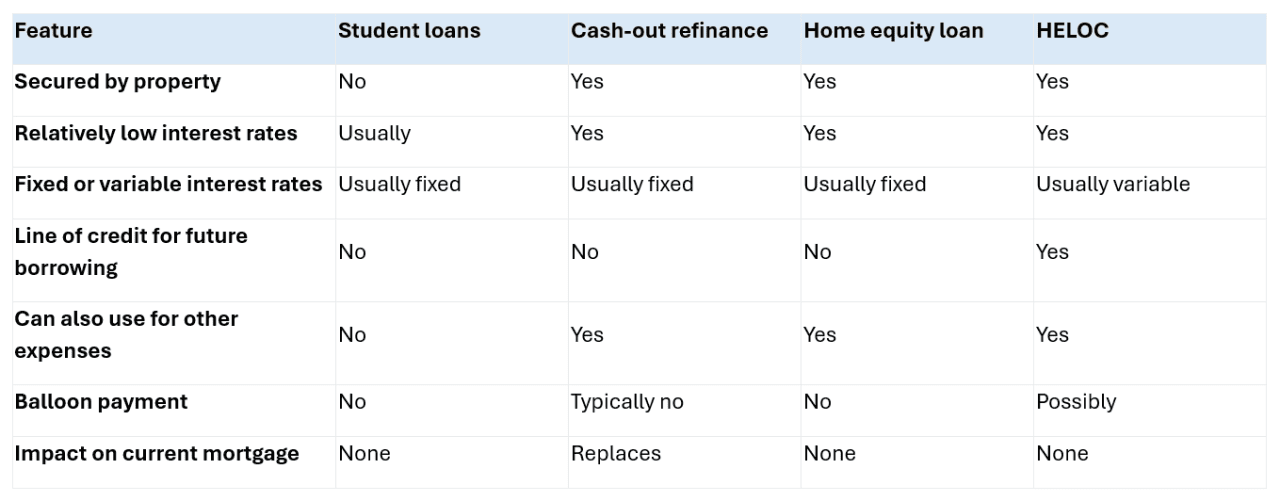
You can choose from several different options for dealing with your student loan debt, depending on your financial situation and goals.
Think of it this way: Using home equity to pay off student loan debt is a viable option to consider. Whether it’s the right choice depends on your situation.
Here's a checklist of things to consider before making this decision:
Here are a couple of examples of when it might make sense to use home equity to pay off student loans:
Lower the student loan rate while keeping your mortgage intact
You have a $15,000 private student loan at 12% with 10 years left to pay. Since taking out that loan, you've built up $100,000 in home equity. Your mortgage is at 3%, so you don't want to refinance that. You prequalify for a 10-year home equity loan at 8%. So, you could apply for a $15,000 home equity loan and effectively lower the interest rate on your student loan debt from 12% to 8%. Even with 1%-2% loan fees, this move could make sense.
Refinance your mortgage with enough cash to pay off the student loan
You owe $320,000 on a 15-year mortgage at a 7% interest rate. You also have $30,000 in student loan debt with an 8% interest rate and 10 years left to pay. Even though you bought your house just a couple of years ago, its value has risen from $400,000 to $450,000. That gives you about $130,000 in equity.
You find that 15-year mortgage rates have dropped to 5%. So you could lower the interest rate on both your mortgage and your student loan debt. Using a loan calculator, you compare your current costs with the cost of refinancing your mortgage and your student loan debt with a $350,000 cash-out refinance loan. Here's what you find:
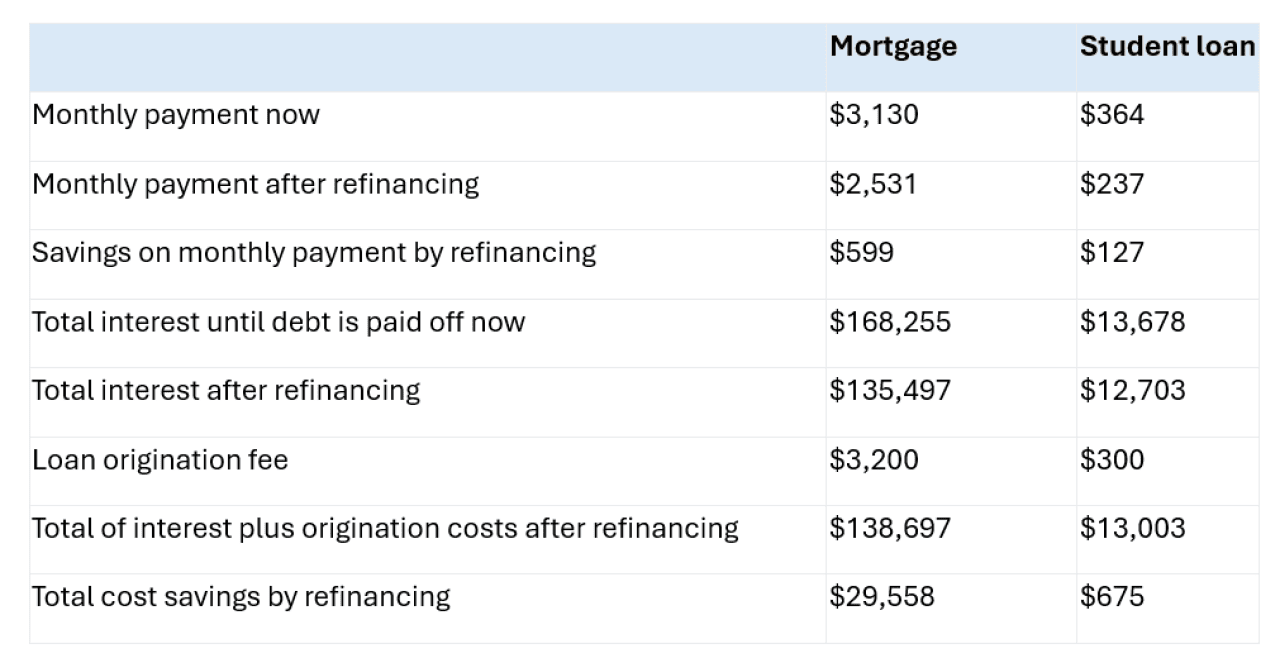
In this case, cash-out refinancing is a clear win. You could reduce the monthly payment and total remaining cost on both your mortgage and your student loan.
Every situation is different. The above are just a couple of examples to show what you should evaluate when considering using home equity to pay off student loan debt. If you don't feel comfortable making this decision, a professional financial planner or debt counselor may be able to help.
A good decision is one you make after thinking through all the outcomes and alternatives. The checklist and thought process described above can help you feel more confident about whether using home equity to pay off student loan debt is the right decision.
This story was produced by Freedom Debt Relief and reviewed and distributed by Stacker.



