
If you’re the finance administrator, treasurer, or chief financial officer (CFO) searching for a credit card for churches, you may already know standard card comparisons can miss how ministry finances actually work. You might be managing staff reimbursements across multiple ministries, tracking restricted donor funds, and producing an audit trail that the finance committee can review each quarter. That gap between ministry finance workflows and standard business card features drives the selection criteria used across each pick.
A church-focused evaluation may be more useful than a generic nonprofit roundup for teams comparing personal guarantee exposure, cardholder controls, accounting workflow fit, and eligibility for religious nonprofits. Broader 501(c)(3) options exist, but these picks apply a narrower screen built for congregations. Brex examines how three cards that cover the main operating profiles for churches in 2026 compare. Each pick includes eligibility requirements, integration details where confirmed, and the personal guarantee position, if available.
A church card program gets judged on criteria most business cards weren’t built around, including personal guarantee exposure, cardholder turnover, and fund-accounting workflows. Before comparing specific cards, identify where standard business cards may fall short in a ministry setting and which questions align with your congregation’s size and structure.
Churches often look closely at whether the organization can carry its own liability. Many business cards require a personal guarantee, which means one individual, often the pastor or treasurer, becomes personally liable for the church’s debt. A new board chair may not want that liability tied to spending decisions they didn’t authorize. Some standard cards can also offer less control over individual cardholders and spending categories than a church may want when issuing cards to staff or volunteers. Fund-designated spending may also require coding and an audit trail that standard bank cards may leave to manual workarounds.
Once you identify the liability and control gap, match the card to the church’s operating profile. Ask yourself:
The gap among those priorities shapes the picks more than rewards rates alone do.
The right credit card depends on how your church manages spending, who needs cards, and how reconciliation happens after each transaction.
The cards were evaluated on personal guarantee terms, fund accounting integration, the ability to issue cards to staff with individual controls, fees and rewards, and eligibility for religious nonprofits. Card pricing and offerings are accurate as of publication, and issuer offerings change frequently. Those criteria create practical differences across the list. They also explain why a card may suit one church profile and fit less well for another.
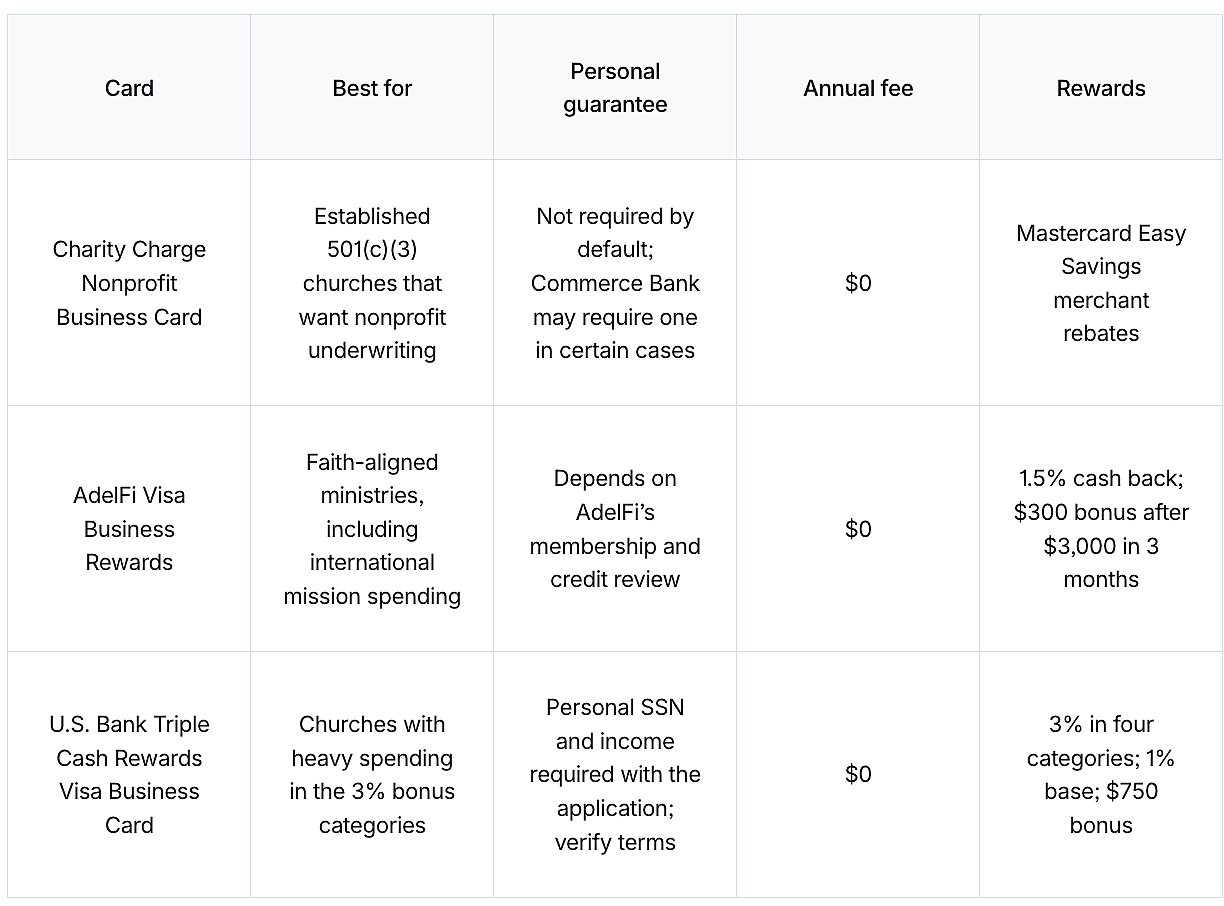
Three credit cards cover the main operating profiles for churches in 2026:
Charity Charge is a nonprofit-focused Mastercard issued through Commerce Bank and built for 501(c)(3) organizations. Churches that value nonprofit underwriting over flat-rate rewards may find Charity Charge the better fit. Earn rewards through Mastercard Easy Savings, a select-merchant rebate program with rates that vary by merchant.
The no-personal-guarantee position is the default, but Commerce Bank may require a personal guarantee in certain underwriting circumstances. Underwriting decisions and account terms depend on the applicant’s organizational profile and Commerce Bank’s review. Eligibility requires active 501(c)(3) status and standard nonprofit documentation, including employer identification number (EIN), IRS determination letter, and board authorization.
For churches already running QuickBooks Online, Charity Charge may fit established operations that want nonprofit-specific underwriting without centering the decision on rewards. Churches using another accounting platform should verify the reconciliation path with their vendor before applying. The vendor verification step matters. Even if the card is a good fit on liability and fees, it could still create manual accounting work.
AdelFi Visa Business Rewards is designed for churches, ministries, and Christian nonprofits seeking a faith-based banking relationship. The card earns 1.5% cash back on net purchases, with a $300 welcome bonus after $3,000 in spending in the first three months. Three card variants let churches align spending with specific mission partners, and mission donations are made by the credit union on the cardholder’s behalf.
Membership eligibility requires Christian ministry affiliation and agreement to AdelFi’s Statement of Faith. Card terms and credit decisions depend on AdelFi’s membership review and the organization’s financial profile. Organizations with frequent international mission spending may prefer the zero foreign transaction fee. For ministries where faith alignment matters as much as fee structure, AdelFi is one of the few card options that builds that alignment directly into the product.
U.S. Bank Triple Cash Rewards Visa Business Card is best for rewards-focused organizations. Before choosing it, churches should confirm both the liability terms and the spending mix that would justify the category structure. U.S. Bank says the primary applicant must supply a personal Social Security number and personal income as part of the business application, similar to a personal guarantee structure, though the card’s terms page doesn’t use that specific term. Verify the guarantee terms directly with the issuer before applying.
The best credit card for your organization depends on your needs. Personal guarantee exposure, fund accounting compatibility, and cardholder turnover can shape your decision in ways a generic business card comparison could miss.
1. Personal guarantee exposure
Personal liability is usually the fastest way to narrow the list. If the church’s governance structure makes it inappropriate for any individual to bear personal liability for organizational debt, that could eliminate the U.S. Bank Triple Cash card, whose guarantee terms are confirmed only indirectly through its application requirements. Some organizations document whichever direction the board chooses in meeting minutes and review that decision with legal or accounting advisors, because the governance question can matter as much as the card terms.
2. Fund accounting compatibility
Each card needs a reconciliation path to your church accounting platform. No confirmed native direct integration was identified with church-specific platforms such as Aplos, Realm, ShelbyNext, ACS Technologies, or ParishSOFT.
Consider asking each provider to demo the exact path from card swipe to fund-coded entry before signing up. The value of any rebate program also depends on how much manual work your team still has to do, especially when comparing rewards tradeoffs.
3. Cardholder turnover
Some churches have seasonal spikes in cardholder activity tied to ministry events, mission trips, or program cycles. Many traditional bank cards may require more manual corporate credit card management, though Charity Charge's unlimited employee cards at no extra cost reduce the cost barrier. If you can easily add and remove cardholders, then it can be easier to keep ministry spending under control without slowing people down.
4. Possible IRS compliance requirements considerations
Some churches build expense reimbursement policies around a few general ideas, including tying each expense to a clear business purpose, keeping expense receipts, and returning unused advances within a reasonable timeframe. Religious institutions should confirm the specific requirements with a qualified tax advisor.
A card program that can capture receipt photos and timestamps transactions may reduce some of that compliance work. Some organizations build their card expense policy around these general guidelines before distributing cards to staff, and they may review that policy with a qualified tax professional or accountant. Churches using platforms that support expense approval workflows may find compliance easier than teams relying on paper processes.
These cards may cover the needs of many churches. Some religious institutions, including denominational offices and multi-campus ministries, may now run finance operations that resemble those of mid-market organizations, with complex reporting requirements. At that point, the decision shifts away from picking the best small-business card and toward finding a platform that can support growth.
For growth and scale, the requirements could shift from transaction management to operational infrastructure. Campus-level budget rollups with a consolidated view at the central office level may be the starting point. Pre-approval workflows for capital expenditures and international mission programs can add another layer. A real-time enterprise resource planning (ERP) sync into NetSuite, Sage Intacct, or QuickBooks Enterprise, with transaction-level data flowing continuously into the accounting platform, can become non-negotiable. Personal guarantees across large cardholder groups and multiple legal entities can also become harder to justify.
Organizations operating at that level may need business-level underwriting, tighter cardholder controls, virtual card issuance, and a direct ERP sync with continuous transaction-level data posting. These platform requirements might matter most for ministries seeking to consolidate oversight across campuses and legal entities without adding manual reconciliation.
Can a 501(c)(3) church get a credit card?
Churches with active 501(c)(3) status are generally eligible to apply for business credit cards under the organization's name and employer identification number (EIN). Some issuers underwrite based on organizational financials, which may reduce the likelihood that a pastor or board member is asked to sign a personal guarantee.
Can a church get a credit card with just an EIN?
Some card platforms underwrite nonprofit organizations based on their EIN and organizational cash balance, with no personal guarantee required. Charity Charge offers this path for qualifying 501(c)(3) organizations, though application review may still include additional underwriting requirements and standard nonprofit documentation.
Should a pastor have a church credit card in their name?
Putting a church credit card under a pastor's name can create personal liability for the organization’s debt.
What credit card integrates with Aplos or church accounting software?
Direct native integrations between these cards and church-specific platforms (Aplos, Realm, ShelbyNext, ACS Technologies, or ParishSOFT) haven’t been publicly confirmed. Charity Charge integrates with QuickBooks Online, which may serve as a bridge for some churches. Verify the full integration path with your church accounting vendor before committing.
How long does it take for a church to get a credit card?
Timelines vary by issuer, from a few business days to several weeks. Gathering the church’s EIN, IRS determination letter, and board authorization before applying might shorten the application process.
How high should a church credit card limit be?
A practical starting point is the church’s average monthly non-payroll operating spend, with room for seasonal peaks like holiday programming and mission trips. Per-cardholder limits could matter as much as the overall limit, since individual controls shape how ministry spending actually happens.
This story was produced by Brex and reviewed and distributed by Stacker.



